Slang vs. Academic English: An ELA Teacher's Perspective
An ELA teacher reflects on the growing challenge of slang and informal language appearing in student writing. This post explores why it happens, the influence of texting and digital communication, and how teachers can help students elevate their language to meet academic expectations without dismissing their cultural voice.
8/3/20263 min read


As an English Language Arts teacher, I spend a great deal of time helping students find their voices through writing. One of the things I value most in my classroom is the diversity of language students bring with them. Language reflects culture, identity, family, and community. The way students speak with their friends or at home often carries warmth, humor, and creativity. I never want students to feel that their everyday language is something to be ashamed of.
At the same time, part of my role as a teacher is to help students understand that different situations require different types of language. Just as we dress differently for a formal event than we do for a casual outing, we also adjust our language depending on the audience and purpose. When students are writing essays, reports, or responding to reading passages—especially on standardized assessments—they must use a level of language that is clear and understandable beyond the classroom.
This is where many students struggle.
Over the years, I have seen a growing number of informal expressions appear not only in classroom writing but even on state examination papers. Students often write exactly the way they speak. For example, I have read responses such as:
“The guy in the story was really mad and did a bunch of stuff.”
“The author was kinda trying to show that the character was sad.”
“The scientist looked into the problem and tried to fix things.”
While the ideas behind these sentences are understandable, the language lacks the precision expected in academic writing. A stronger version might read:
“The character in the story was extremely angry and took several actions.”
“The author attempted to show that the character was experiencing sadness.”
“The scientist investigated the problem and attempted to resolve it.”
These revisions do not change the students’ ideas; they simply elevate the language so the writing becomes clearer and more effective.
One major influence I have observed over the years is the impact of constant digital communication. Students today spend a significant portion of their day texting, messaging, and interacting on social media. These platforms encourage quick, abbreviated communication. Speed becomes more important than accuracy, and informal expressions become the norm. Over time, these habits naturally carry over into academic writing.
However, the world beyond school—college courses, professional communication, and many careers—expects a different level of clarity and formality. When students sit for state exams or write essays that will be evaluated outside their classroom, the audience does not know them personally. Their writing must stand on its own and communicate ideas in a way that any reader can understand.
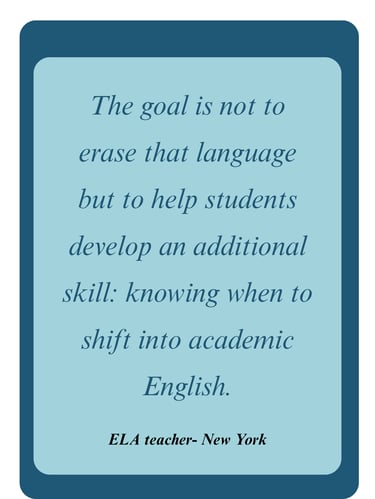
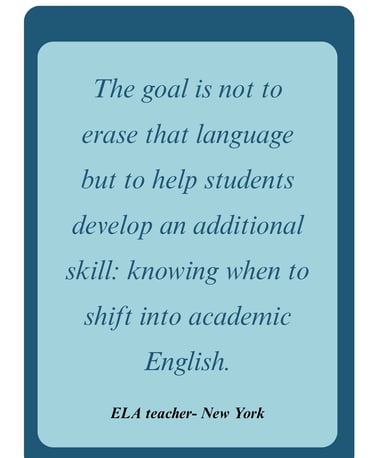
This does not mean eliminating slang or informal language from students’ lives. Those forms of expression have a place in everyday conversation and cultural identity. The goal is not to erase that language but to help students develop an additional skill: knowing when to shift into academic English.
In my classroom, I often explain it this way: students are not losing one language style; they are adding another tool to their communication skills. When they learn how to revise sentences, replace informal expressions with precise vocabulary, and structure their ideas more clearly, their writing becomes stronger and more powerful.
Ultimately, teaching the difference between slang and academic English is about preparing students to communicate beyond the walls of the classroom. When students learn how to elevate their writing, they gain the ability to share their ideas with a wider audience—teachers, exam evaluators, future professors, and eventually colleagues in the professional world.
And that is a skill that will serve them far beyond any single assignment or test.