
Worried About Your 3rd Grader’s Reading Level? Here’s What You Need to Know
Is your third grader struggling with reading? Third grade is a turning point where students begin reading to learn, not just learning to read. This post breaks down what parents should know and offers practical ways to help children improve reading skills and gain confidence.
Building Strong Vocabulary Before Third Grade: What Teachers and Parents Should Know
If you’ve ever worked with children in the early grades, you’ve probably noticed something interesting: two students can read the same passage, yet one understands it easily while the other struggles. Often, the difference is vocabulary.
By the time students approach third grade, vocabulary begins to play an even bigger role in learning. This is the stage where children transition from “learning to read” to “reading to learn.” In other words, reading is no longer just about sounding out words—it becomes the main way students learn science, social studies, and new ideas across subjects.
Both teachers and parents sometimes wonder: What kinds of words should children know before reaching third grade? While there isn’t one perfect list, research shows that students benefit most from learning high-utility words—words they will see and use across many subjects and texts.
Researchers such as Isabel L. Beck, Margaret McKeown, and Michael Graves have emphasized the importance of teaching vocabulary directly and in meaningful ways. Their work shows that when children learn useful words and practice using them in conversation and reading, their comprehension improves significantly.
Why Vocabulary Matters So Much
According to the National Reading Panel, vocabulary development is one of the five essential components of reading success, along with phonemic awareness, phonics, fluency, and comprehension.
Students who build a strong vocabulary early tend to:
understand texts more easily
read with greater confidence
grasp new concepts faster in science and social studies
Reading researcher Keith Stanovich described what he called the “Matthew Effect in Reading.” Simply put, students with strong vocabulary skills tend to keep improving because they understand what they read. Students with limited vocabulary may struggle more, which can make reading feel frustrating.
The encouraging news is that vocabulary growth does not require complicated programs or long lessons. Small daily habits can make a meaningful difference.
Simple Ways Teachers and Parents Can Build Vocabulary
One of the most effective ways to strengthen vocabulary is through daily exposure to language in meaningful situations. Research consistently shows that children learn words best when they hear them, see them, and use them in conversation.
Here are a few simple strategies that work well both at home and in the classroom:
Read aloud regularly.
Even older elementary students benefit from hearing books read aloud. When adults pause to explain interesting words or ask questions, children naturally begin to understand new vocabulary.
Talk about words during reading.
When a new word appears in a story, take a moment to discuss it. Ask children what they think the word means based on the sentence or picture.
Encourage children to explain ideas in their own words.
When students describe something, they learned, they practice using new vocabulary in meaningful ways.
Play word games and storytelling activities.
Simple activities like storytelling, word guessing games, or describing objects can strengthen language skills while keeping learning fun.
A Small Daily Habit Makes a Big Difference
One reassuring finding from literacy research is that vocabulary growth does not require hours of extra work. Even 10–15 minutes of reading and conversation each day can significantly improve a child’s vocabulary over time.
For teachers and parents alike, the goal isn’t to teach hundreds of isolated words. Instead, it’s to create environments where children hear rich language, ask questions, and feel comfortable exploring new words.
When that happens, something powerful begins to develop—confidence in reading. And that confidence becomes the foundation for success, not just in third grade, but in learning for years to come.


Get the Free Vocabulary List! Download the printable guide of must-know words before third grade and help your child grow into a confident reader.
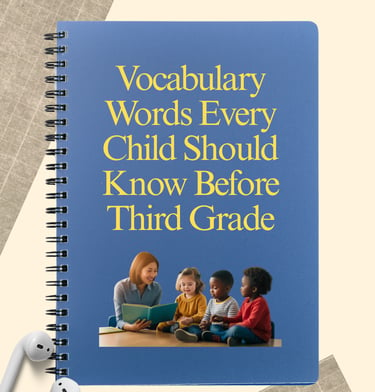
Help your child build the vocabulary skills needed for confident reading. Download (in-store) this free printable guide with essential words students should know before third grade.
Many parents begin to worry about reading in third grade, when students shift from learning to read to reading to learn.